
Selected Engineering Projects
Representative engineering projects demonstrating how physics-based simulation, precision measurement, and prototype development help solve complex acoustic and vibroacoustic challenges.
Due to confidentiality agreements, projects are presented in anonymized and representative form.
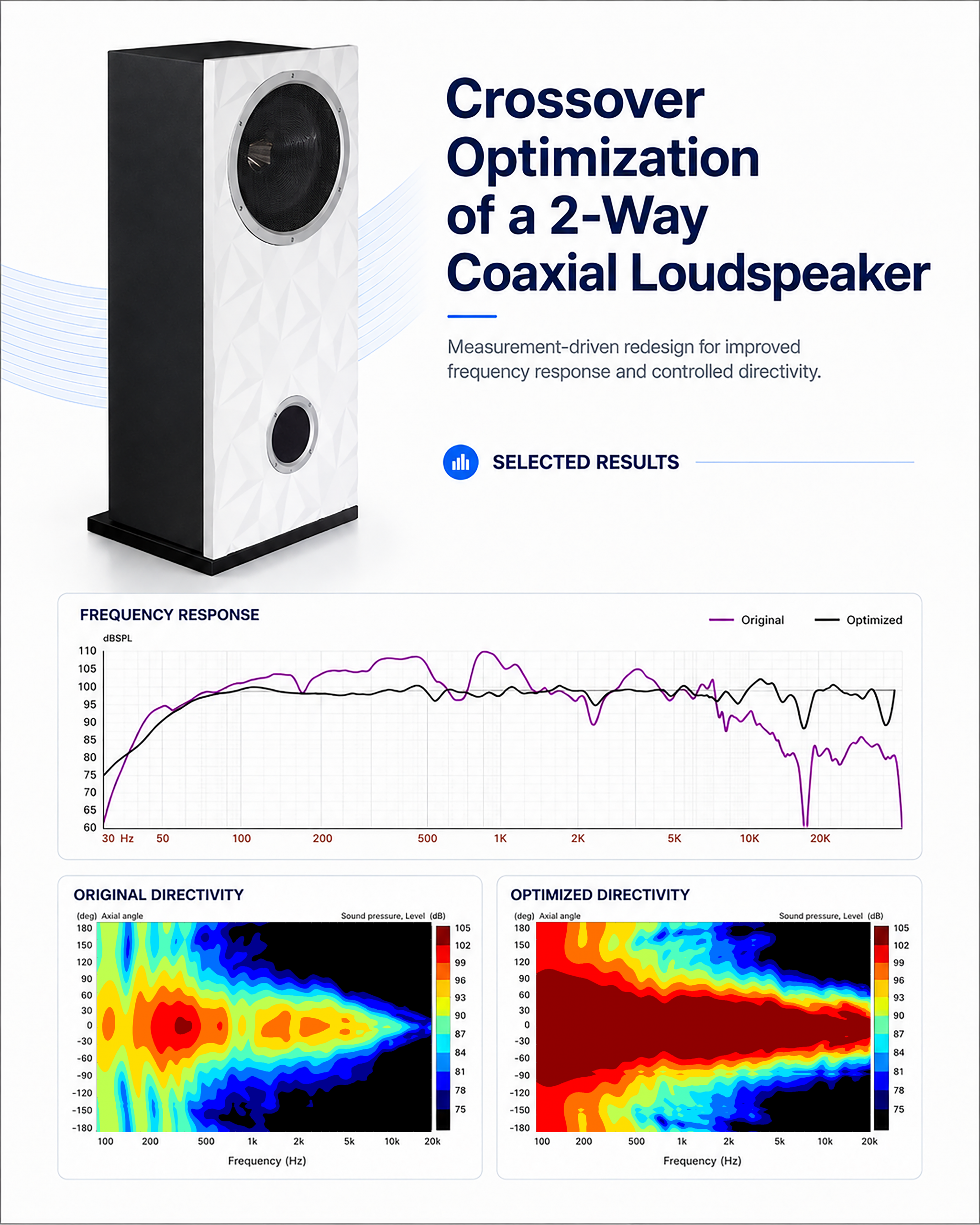
Crossover Optimization of a 2-Way Coaxial Loudspeaker
A measurement-driven redesign of a 2-way coaxial loudspeaker system with focus on frequency response, crossover integration, impedance behavior and controlled horizontal directivity. The project included original system measurements, separate driver analysis, crossover simulation, component selection, damping optimization and final acoustic validation.
The optimized system achieved a more linear frequency response, improved impedance behavior and a more controlled radiation pattern, resulting in a more balanced and predictable loudspeaker performance.
Measurement · Crossover Design · Directivity · Loudspeaker Optimization
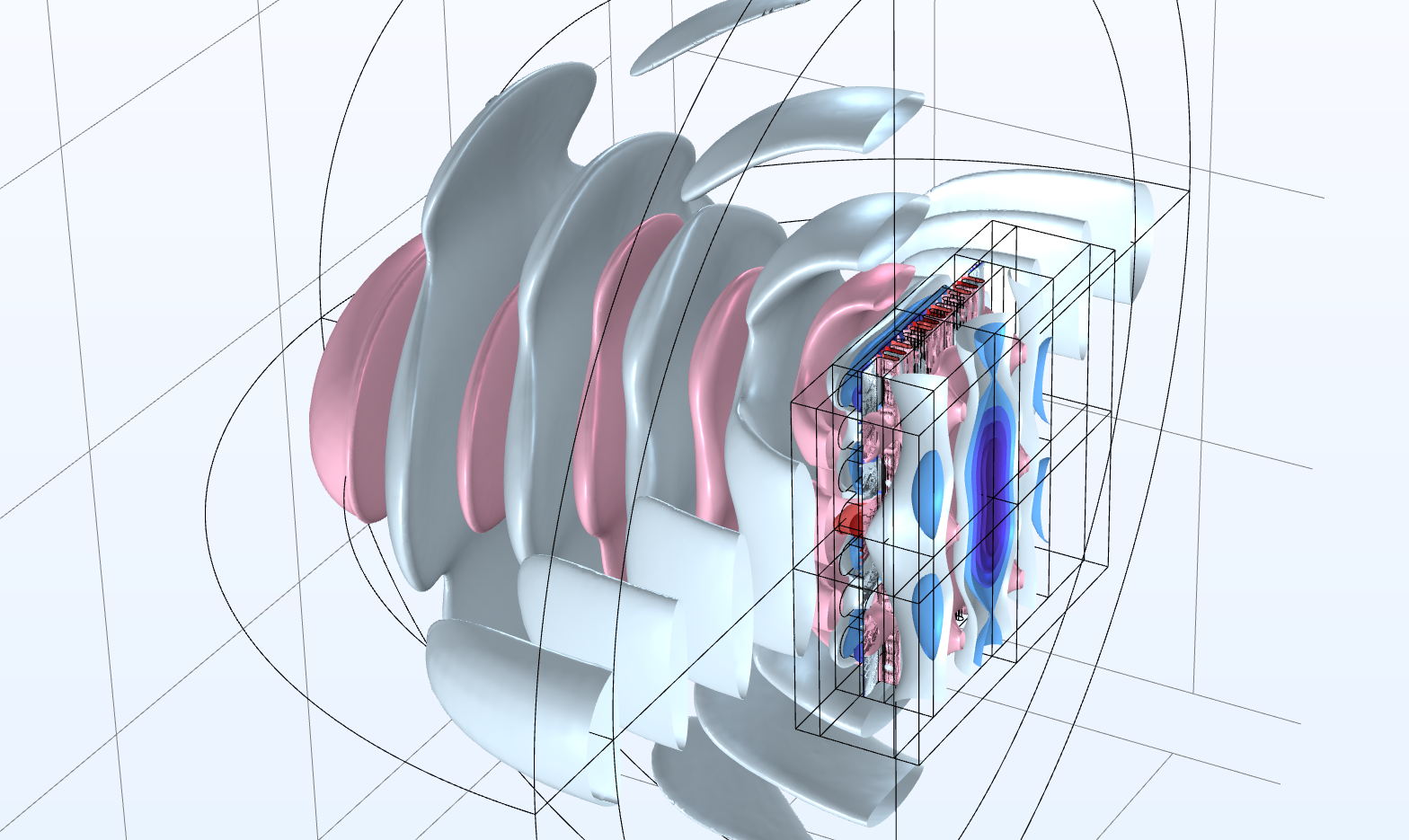
Multiphysics Simulation of an Air Motion Transformer Transducer
A research-based technical study investigating the acoustic, vibroacoustic and electromagnetic behavior of an AMT transducer using COMSOL Multiphysics.
The work follows a step-by-step modeling strategy, from simplified 2D and 3D acoustic radiation models to a coupled electroacoustic simulation including structural foil motion, magnetic field distribution and Lorentz-force excitation.
COMSOL Multiphysics · Acoustic Simulation · Vibroacoustics · Magnetic Field Modeling · Transducer Physics
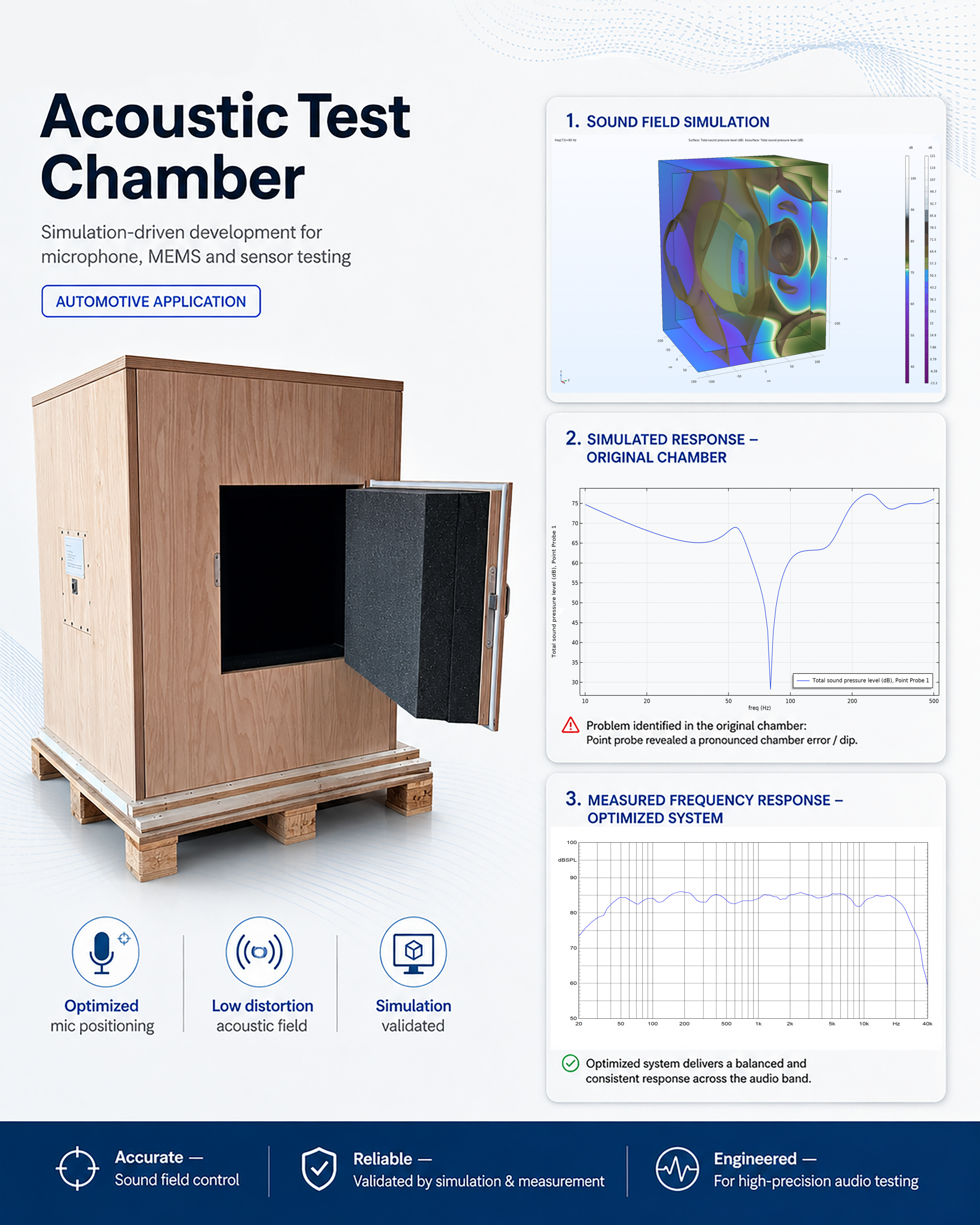
Acoustic Test Chamber for Automotive Sensor Validation
A compact acoustic test chamber with an integrated low-distortion passive loudspeaker system was developed for microphone, MEMS and sensor testing. The required operating range of 100 Hz to 10 kHz was exceeded, providing a stable acoustic environment for repeatable measurements.
COMSOL simulations were used to analyze the internal sound field, identify the original chamber response issue and define an optimized microphone position before final validation. The result is a simulation-verified acoustic test setup for high-precision sensor development.
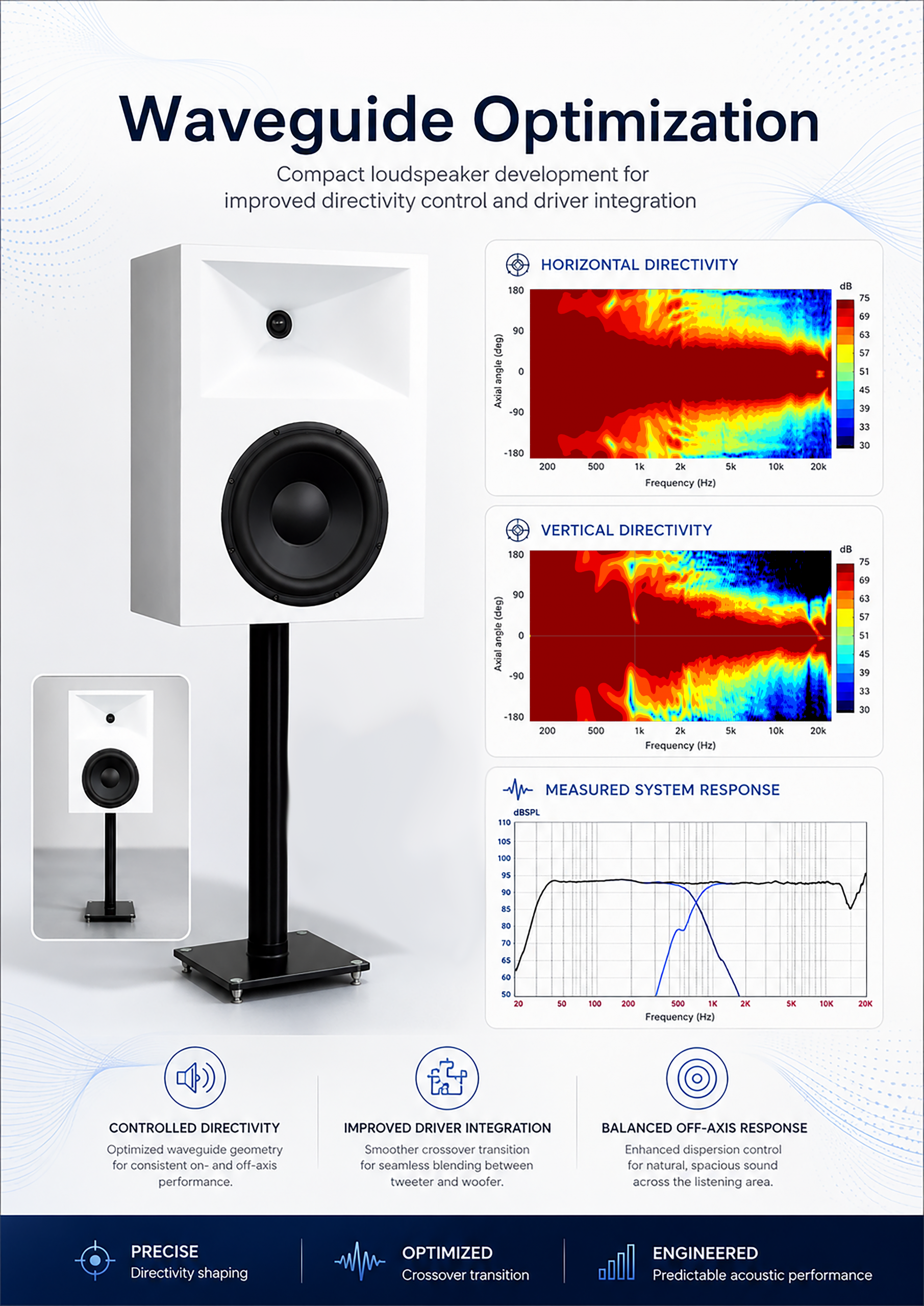
Waveguide Optimization for a Compact Loudspeaker
A custom waveguide was developed to improve directivity control and driver integration in a compact passive loudspeaker system. Horizontal and vertical polar data were used to optimize the radiation behavior, crossover transition and overall tonal balance.
The result is a more controlled dispersion pattern, smoother off-axis response and a compact loudspeaker design with predictable acoustic performance.
Waveguide Design · Directivity Control · Loudspeaker Optimization · Polar Response
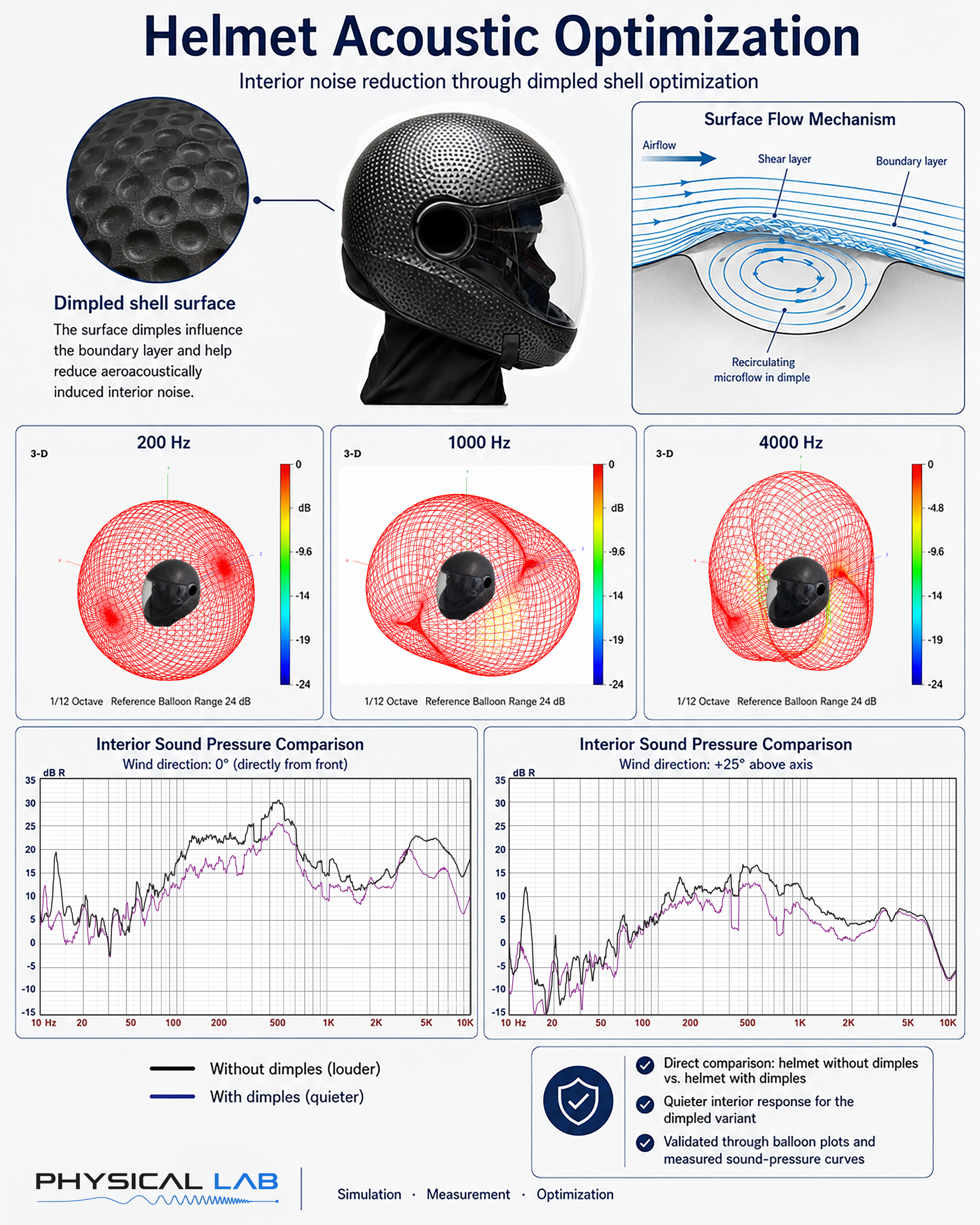
Helmet Aeroacoustic Noise Optimization
This exploratory study investigated whether an acoustically optimized dimple structure can reduce flow-induced noise inside a helmet. A conventional helmet configuration was compared with a modified dimpled version under multiple airflow directions and incidence angles.
The results indicated lower critical sound pressure components for the dimpled configuration. The focus was not only on reducing the overall level, but on improving the spectral balance: shifting acoustic energy away from low-frequency components that can cause fatigue, while avoiding an increase of high-frequency turbulent noise above the perceptual threshold.
The study also showed the importance of structure-acoustic coupling. The mechanical damping of the helmet shell needs to be considered together with the wall-pressure fluctuations induced by the airflow and surface geometry.
Due to the complexity of aeroacoustic phenomena, the results should be understood as an exploratory investigation. A next step would be a deeper numerical analysis using high-resolution methods such as Lattice-Boltzmann Methods or Large Eddy Simulation.
Key Findings
– Comparison of conventional and dimpled helmet geometry
– Reduction of critical internal noise components observed
– Evaluation under multiple airflow directions and incidence angles
– Focus on spectral optimization and structure-acoustic coupling
– Further validation recommended using advanced aeroacoustic simulation.
Have a complex acoustic development challenge?
Whether you need simulation, measurement, root-cause analysis or prototype optimization,
PHYSICAL LAB can support your next engineering decision with physics-based insight and practical development experience.